
Description
Pearl Kan
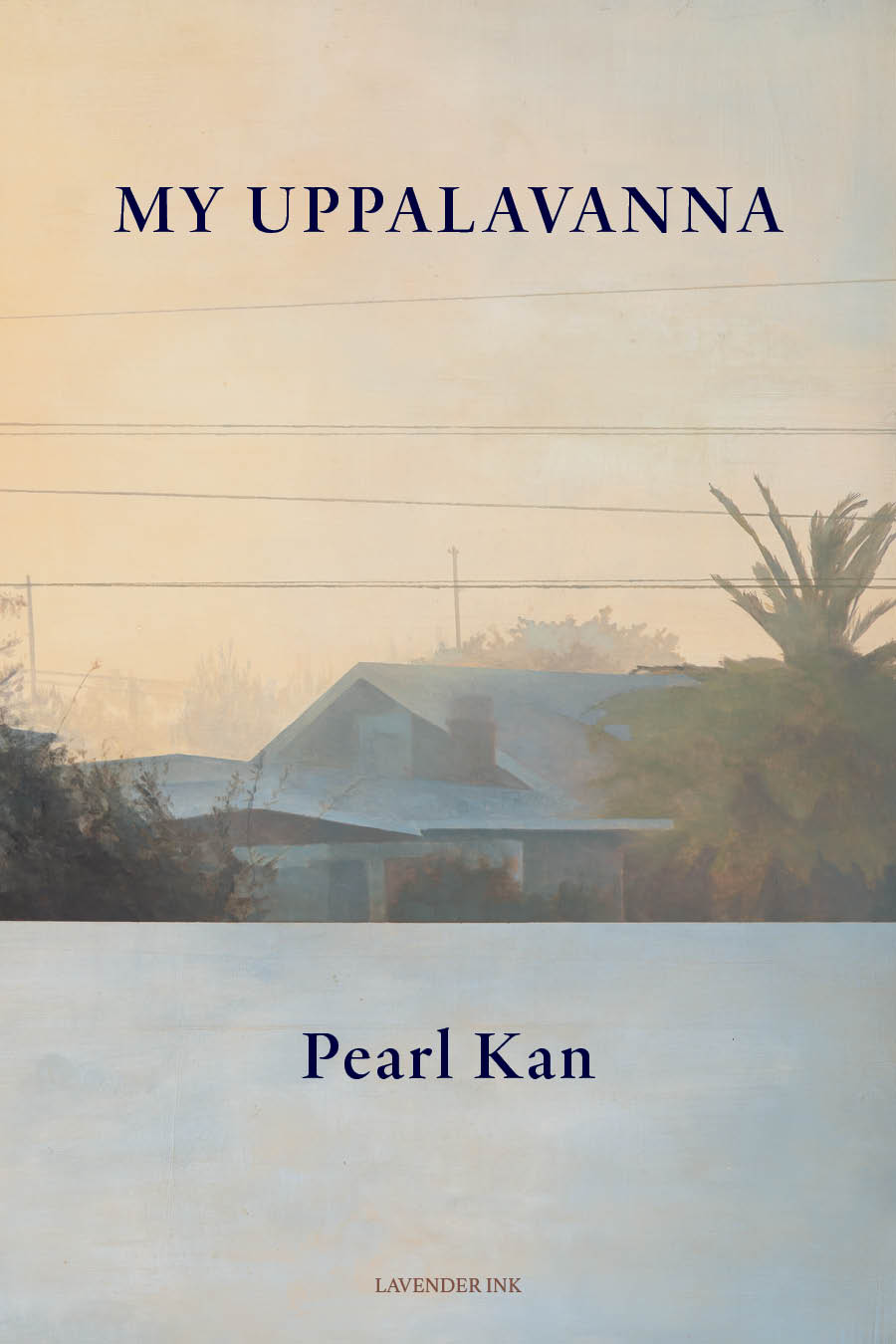
My Uppalavanna
ISBN: 978-1-956921-80-9 (pbk.)
(September 1, 2026)
My Uppalavanna takes its title from the legendary Buddhist nun who was enlightened by staring into lamplight as she swept in the evening—and Pearl Kan’s debut collection follows that luminous, domestic gesture into the fullness of contemporary life. Navigating the paradox between spiritual emptiness and the irreducible particulars of the world—lost teeth and dynamited buddhas, pelicans low against the cold sea, a child’s sunrise lifted on butter and milk—these spare, precise poems move between Zen practice, motherhood, and the mystery of everyday perception with utter clarity. Both incantatory and quietly vernacular, My Uppalavanna is an astonishing first collection.
Praise
These spare, exquisite poems by Pearl Kan contain multitudes. Takeout, potatoes, a shoe—all are so much more than they seem. What if the priest/poet Ryokan were also a mother living in the 21st century? “You can lift little sunrise/tend to it with butter/and milk such soft/devices.” Each poem is a treasure, beautiful and profound.
—Stefany Anne Golberg, author of My Morningless Mornings
A nun, Uppalavanna was one of the Buddha’s leading disciples, famed for her psychic powers. She was enlightened by staring deeply into the lamplight as she was sweeping up in the evening. In My Uppalavanna, her debut collection, Pearl Kan does for her what Susan Howe does for Emily Dickinson in her classic My Emily Dickinson: fully inhabit the mind and heart of her great predecessor, giving her new life. In spare, elegant, delicate poems and poem sequences, Kan writes of the mystery of everyday perception and the strange joy of living in the world with a limitless mind. “evening brighter/ than fire/ song/ of living”…
—Norman Fischer, author of Selected Poems 1980–2013, and There Was a Clattering As…
Rarely do we encounter a first book of poetry like My Uppalavanna, so accomplished, poised, and engaging. It pays to wait; it pays to take time; it pays to turn away and return to the practice of poetry with a beautifully enriched and unforeseen range of nutrients, including Zen practice, motherhood, and life with two young daughters. Pearl’s “miraculous / vernacular” is “in time / a plain devotion,” emotionally engaged and quietly intelligent without becoming overly self-dramatizing. These poems are adventures and instances of attention, affection, humility, perspective, and play. “Adorned with words / that glint at joy,” the variety of joy that Pearl provides is the deep pleasure of a sustained and sustaining balance and alertness. In a “vertiginous hour / slender to the touch / I step through / shoulder first / into cold air,” and we are invited to take that step with Pearl as she prepares for ordination as a Zen priest and as her writing life begins to unfold. She says, “here I am / scratching at the door / again,” and we can hope that she continues to scratch, question, observe, and share with us the ongoing remarkable gift of her poetry.
—Hank Lazer, author of The Silver Bowl Is Filled with Snow and Covid-19 Sutras
Reading Pearl Kan, I am reminded that ‘prayer’ and ‘precarity’ share a root. In her delicate, mysterious poems, Kan offers a sense that things might be otherwise: “eating cacio e pepe at the bar/ a field of wild sweet peas in North Fork,/ pelicans low against the cold sea,// and just barely.” My Uppalavanna includes poems to intimates, a gorgeous praise poem called “Merci bon Dieu,” poems inspired by Caspar David Friedrich and the Bamiyan Buddhas. Here is the world, in short lines and surprising branchings of syntax where grief, impatience, and nonattachment form a remarkable sensibility: “I want to/ be in this world/ with you/ curl out to/ shore sand.”
—Nate Klug, author of Hosts and Guests
The vision of a poet-priest, My Uppalavanna dwells in a paradox: how to reconcile the fullness of life with the emptiness enshrined by spiritual doctrines, when we know both to be unbearably true. The poems gathered here are songs of living and child-rearing, populated by lost teeth and dynamited buddhas, the cycles of seasons and the unrepeatable particulars of home. Pearl Kan has given us an astonishing first collection: incantatory, affectionate, and wise.
—Anna Della Subin, author of Accidental Gods: On Men Unwittingly Turned Divine
Kan skillfully traces the edges of our senses in My Uppalavanna, guiding us toward a clarity of vision that only reveals itself, it seems, when we approach the brink of the sayable. Moving fluidly between the quiet, small particularities of everyday life and the vastness of existential inquiry, these stripped-down poems pull focus in and out of a large world in small, small world in large—reminding us of the complexities hidden within the simple joys of family, earthly surroundings, and spiritual life.
—Sho Sugita, poet and translator of Hirato Renkichi’s Spiral Staircase: Collected Poems
Kan’s work is wonderfully arresting in its stark distillations; her vocabularies of silence are deployed to profound effect. She can deftly coax out the incommensurable and unsayable through the explosive energies between fragments.
—Jenny Xie, author of Eye Level
Pearl Kan’s My Uppalavanna is a book of light: each word, each syllable, shines. We are taken into the sources of life with extraordinary immediacy. The voice in these poems is graceful and magical, enraptured and canny, a trickster, playing the music of self-awareness. Everyone will understand these poems: nothing is concealed: there is no secret except being alive. The poems embody presence and attention, they enact what it really feels like to move through the world. My Uppalavanna is a first book that doesn’t feel like a first book—and it announces the beginning of a brilliant career—it is a stunning debut, a necessary book.
—Joseph Lease, author of Fire Season



Reviews
There are no reviews yet.