
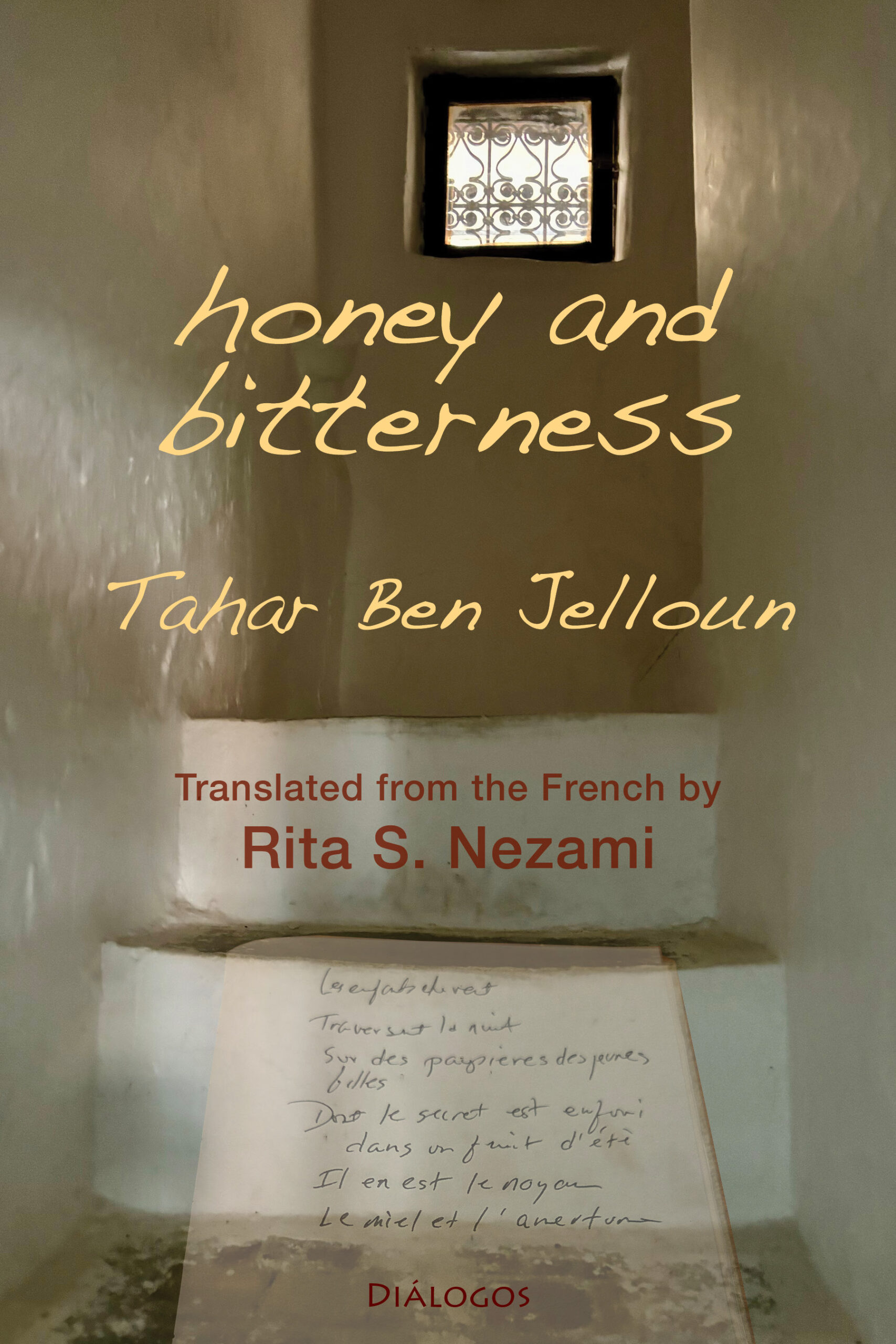
Description
Tahar Ben Jelloun
Honey and Bitterness
Translated by Rita S. Nezlami
ISBN: 978-1-956921-77-9 (pbk.)
(Feb. 16 2027, 2025)
Set in exotic Tangier, Honey and Bitterness unfolds as a chorus of monologues: Mourad, a retired civil servant haunted by his own corruption, and his wife Malika, equally tormented, have retreated to the basement of their once-prosperous home after a family tragedy has left their marriage a ruin of recrimination and silence. Their voices are interwoven with those of their sons, and of Samia, their teenage daughter, whose diary entries and poems scattered throughout the novel reveal a gifted and solitary young poet; and of Viad, the Mauritanian scholar without papers who has fetched up in Tangier dreaming of Europe and becomes an unlikely caregiver to the couple in their decline. Jelloun uses this intimate domestic tragedy as a lens on contemporary Morocco—its rampant corruption, the oppressed lives of women, the racism toward sub-Saharan Africans, and the enormous human cost extracted by a society that enforces silence on those it has already broken.
From the Afterword by Rita S. Nezami
…
Translating Honey and Bitterness became a deeply emotional experience. Every chapter in which Samia is the narrator felt raw with her experience of fear, frustration, desperation, hopelessness, and darkness with no hope of light. Samia is a young poet and a lonely soul—it was only in her writing that Samia could express herself; her pain is palpable, especially in her end-of-chapter poems. Her words are a cry for help in a society that looks away. Samia’s struggles became palpable for me as a translator. I couldn’t look away from this novel; it was my moral obligation to translate the work in a world where rape and suicide are widespread.
Literary translation is a deeply personal and visual experience for me. I am transported to Ben Jelloun’s social and cultural reality; the translation process becomes an immersion into the characters’ lives and social fabrics. I lived for several years in Morocco; I savored, studied, and loved the culture. So, when Monsieur Ben Jelloun uses Arabic words in his French text, I understand their meaning and visualize the places and artifacts. I believe only a complete immersion in a writer’s culture allows any translator to offer an authentic translation that is as close as possible to the writer’s reality. Unknown and untranslatable words literally appear before my eyes as I walk through the streets in Morocco. How else would I know what the phrase “wall of idlers” means (in another novel) if I hadn’t seen a group of young men sitting on a low wall in Tangier facing the Mediterranean? These were unemployed men dreaming of crossing the sea to reach Spain. Likewise, how would I know what “kissaria” means if I hadn’t seen a building with the word written on the front? A kissaria signifies two rows of tiny stores on either side of a passage inside the building. Such details can easily be explained on the glossary page.
Translating Honey and Bitterness, however, did not involve translating many such details that are exclusively Moroccan or from the region. I believe the writer wanted to show how universal such themes as rape and suicide can be. Thus, he wrote the novel in simple, straightforward language and not in his often-poetic style. Ben Jelloun wants to condemn acts of violence, including rape, and unmask societies’ apathy, both of which can be endemic in the Middle East and North Africa (MENA) region and in conservative Muslim societies. While it is first and foremost a work of art, Honey and Bitterness is an invitation for readers to experience outrage and empathy for victims.
I translate to give Western readers access to art from a corner of the world where we can see global issues that cry out for our attention. I translate because I want to understand the world better. I translate to generate knowledge about foreign cultures. I translate because translation builds bridges among cultures. I translate because there are urgent stories to tell. And I translate Tahar Ben Jelloun because he is an engaged writer who can help us become compassionate readers.
Reviews
There are no reviews yet.