
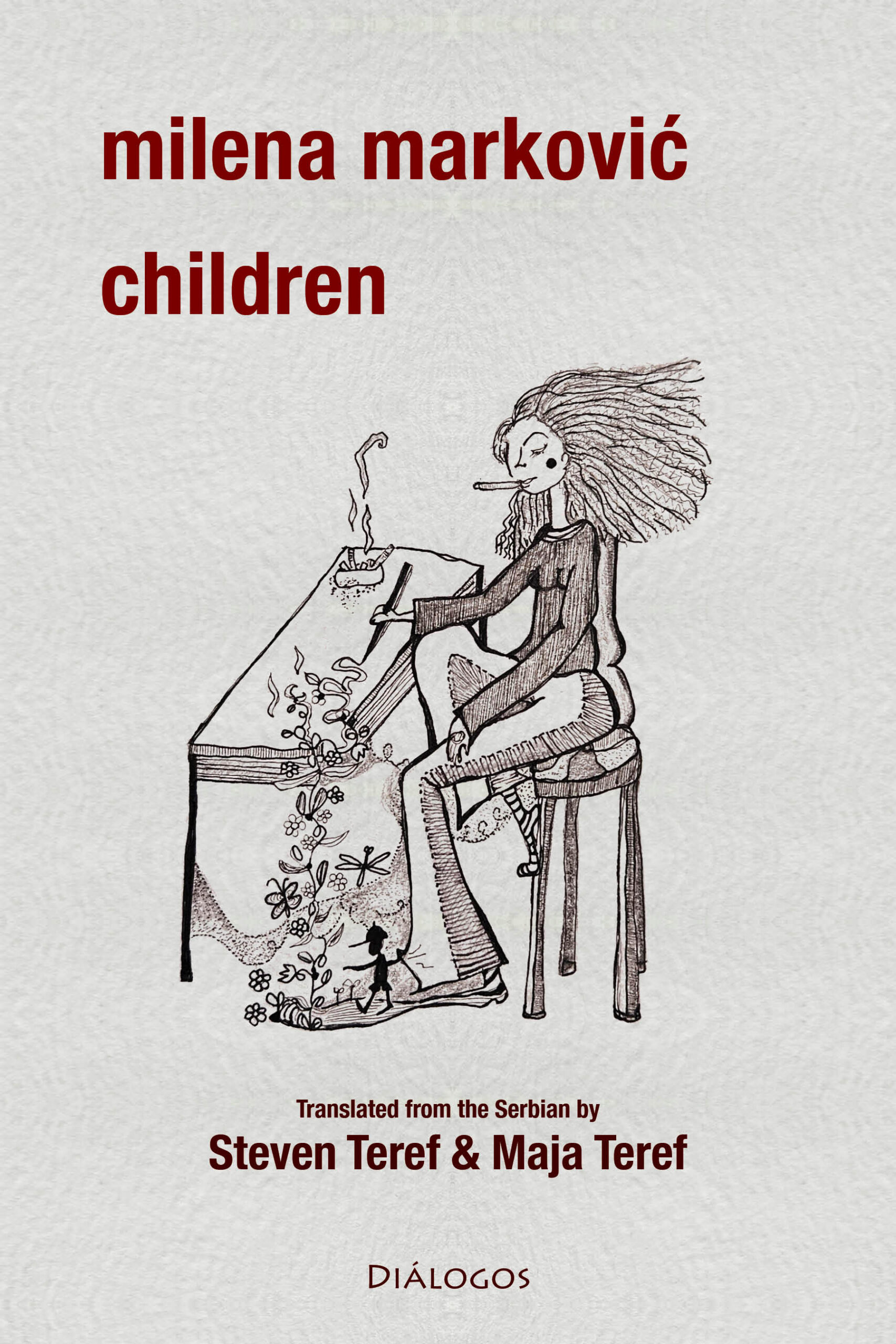
Description
Milena Marković
Translated by Steven Teref & Maja Teref
Children
ISBN:978-1-956921-71-7
Paperback, 216 pages, October, 2026
Cover drawing: Naoko Fujimoto
“walk far my son / live learn watch forgive / and forget / nothing.”
This book-length poem by one of Serbia’s most celebrated poets, playwrights, and screenwriters won the NIN Book of the Year Award—Serbia’s most prestigious literary prize—upon publication in 2021, and has since been adapted into an opera at the Belgrade National Theatre and a play by Zagreb’s De Facto Theatre, and was awarded the 2026 Münster International Poetry Prize for the German translation by Mirjana and Klaus Wittmann.
Writing in a breathless stream of consciousness, Milena Marković traces her life from childhood in the concrete apartment blocks of New Belgrade through adolescence, early motherhood, middle age, and the threshold of old age. Summers on the Adriatic coast, cigarettes and punk rock in Belgrade, a predatory grandfather, while the Bosnian War flickers at the margins. At the narrative’s center is the birth and raising of her first son, Ognjen, born extremely disabled, their relationship rendered with unflinching honesty.
Children offers no consolation, yet somehow delivers it. Perhaps this is what made it such a phenomenon in Serbia, read and loved by shopkeepers and schoolteachers, gallery workers and taxi drivers, as well as poets and critics. Marković’s voice is punk, tender, caustic, and visionary: the voice of a woman who applies the same unsparing gaze to herself that she turns on everything else.
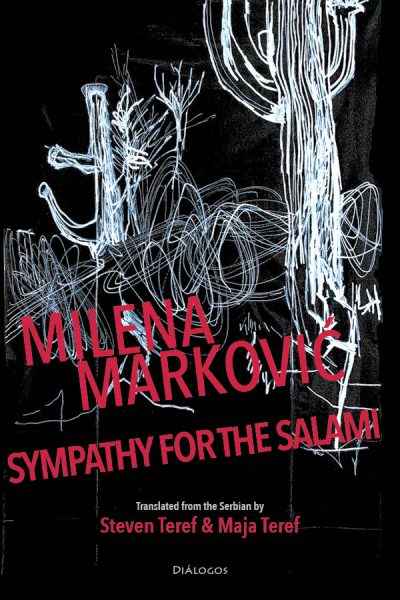
This brilliant English translation by Steven Teref and Maja Teref follows their other Marković collection, sympathy for the salami (Diálogos, 2024), which was longlisted for the 2025 National Translation Award.
Praise for Children
The penetrating voice we hear in Children urges, rivets, aches, rejoices and scathes. There is not a word out of place, line after line. Milena Marković, Maja Teref and Steven Teref send us tumbling, scrambling, crawling, rolling and singing through children, seasons, life.
—Ellen Elias-Bursać, translator of Dubravka Ugrešić
Brimming with unapologetic womanhood, Children is breathless, raw, poetic, and heartbreakingly funny. It is a book of longing, of the ache of a motherhood different from the one we imagined, a book born of a very primal, violent place: our Eastern European childhoods. Steven and Maja Teref’s translation from Serbian is nothing short of brilliant—sharp and alive, it dances fearlessly in step with the unruly choreography of the original.
Izadora Angel, translator of She Who Remains by Rene Karabash, 2026 International Booker Prize shortlist.
Praise for sympathy for the salami
In sympathy for the salami, we hear a vivid, honest, often funny, sometimes disturbing voice from this Serbian poet who confronts her life more directly than most of us have the courage to do. As she tells us, she writes for everyone, the living and the dead and those who won’t die, and for the children who “walk in the murk,” so they can find the way out of it. She herself is still in it, and she has learned that “the murk is not the worst place/the end is not the worst place/fear is.” Whether she is describing wild parties or delirium tremens, a love affair or her grandfather grabbing his granddaughters behind the house, even her ambivalent feelings toward the disabled son to whom she gave birth when she was not much more than a child, she remains fearless. At times, the rush of language and the bohemian scenes remind me of Frank O’Hara, at other times her despair makes me think of Billie Holiday greeting her heartbreak. But Milena Marković is very much her own self, and Maja and Steven Teref have found a muscular English to embody her voice and make us forget that she does not live just down the street.
—Susanna Lang, author of Travel Notes from the River Styx, and translator of My Soul Has No Corners by Souad Labbize
A bold dystopian account of a woman’s physical and emotional journey sans termination. The meat of Marković’s poetry is focused on the inner life of a woman coming of age in the traumatic post-conflict transition of the world around her. A torrent of disparate words laden with feelings of love, passion, fear, regret, sorrow, disillusionment—the pandemonium of a quotidian life. Her narrative is straightforward with no exposition. Her self-denunciation harsh, her language bold, her faculty of emotions immense. sympathy for the salami illustrates the author’s innovative style, which can be read as her appeal to reconcile with fate. Marković’s poems are a powerful read in any language you choose, even in one you do not understand. They contain a steady beat, the familiar cadence of a song or an epic—something that resonates with you long after you put the book down. Laurels to both the poet and the translators who provided us with this fine-tuned English edition of the original verses.
—Nada Petković, University of Chicago
Welcome to the brilliant, incisive, and feral world of Milena Marković’s poems, where the rats are “fat as piglets” and where we’re not afraid “to laugh at the wolf / to spit at the boar / to soar with the birds.” The brisk, hauntingly dreamlike narratives of sympathy for the salami remind us, poem after poem, how terrifying and exhilarating it is to desire and to be desired. Huge thanks to Steven and Maja Teref for this rich and evocative translation from the Serbian—for the care and mindfulness with which they cross
linguistic and cultural borders.
—Tony Trigilio, author of Craft: A Memoir
This book fits Richard Hell’s definition of punk: “anti-authority, independent, tricky, unsentimental, dirty, quick, subversive, guiltless.” I was mesmerized by the squalor of Marković’s Belgrade and the quickness and energy of her lines. But more than that, I was and am especially in awe, given that the book’s subjects are largely family and the past, of its unsentimentality and guiltlessness. These poems love only honesty. They will never stoop to comfort. Violence and impassivity are almost an aesthetic here. The past is present tense, and it’s met with curiosity and without apology: “my hair is filthy there is no water / my scalp is bleeding from scratching / I’m waiting for summer so I can wear a tube top / and go to the sava / they can keep bombing.” There seems no group to which this voice belongs—certainly not patriots, not academia though Marković is a professor, not mothers though she is one of those too—she does not even have a home among her beloved dead. The only institution that might claim her is poetry. But her hurtling and defiant poems show that she, like many great poets, is a stranger even there. So grateful to finally have this bilingual collection deftly translated by Steven Teref and Maja Teref, and yet beware, sympathy for the salami will only make you hungry for much more Marković.
—Darcie Dennigan, author of Madame X
In the hands of the brilliant translators, Maja Teref and Steven Teref, Serbian poet Milena Marković’s ambivalence about her hedonist and raucous “sex, drugs, and rock ’n’ roll” youth—“I dread the past / and sometimes yearn for it”—spirals wider and deeper into meditations on restlessness and recklessness throughout a lifetime. We need to take risks to stay alive, grow, and transform, even as doing so comes with dangers from without and from the self’s inclination to self-harm. Some of my favorite poems in this gritty and witty collection are the ones about the speaker’s devotion to food, which is perhaps the older self’s compromise with the younger. Many of these poems are epicurean, epistolary, elegiac, brutal, and tender in surprising turns—“is there anything more beautiful / than roast piglet.” For English language readers in the 21st Century, this collection is a must. It builds hyperlocal worlds, defamiliarizing to those of us in the so-called West, but simultaneously manifests hybrid, global worlds. The speakers allude to English language literature and the rhythms and icons of American popular culture, while challenging ‘us’ to see past our blind spots. Grab yourself a copy and hold on for the ride.
—Virginia Bell, Editor of RHINO Poetry, and author of Lifting Child from the Ground, Turning Around


Reviews
There are no reviews yet.