
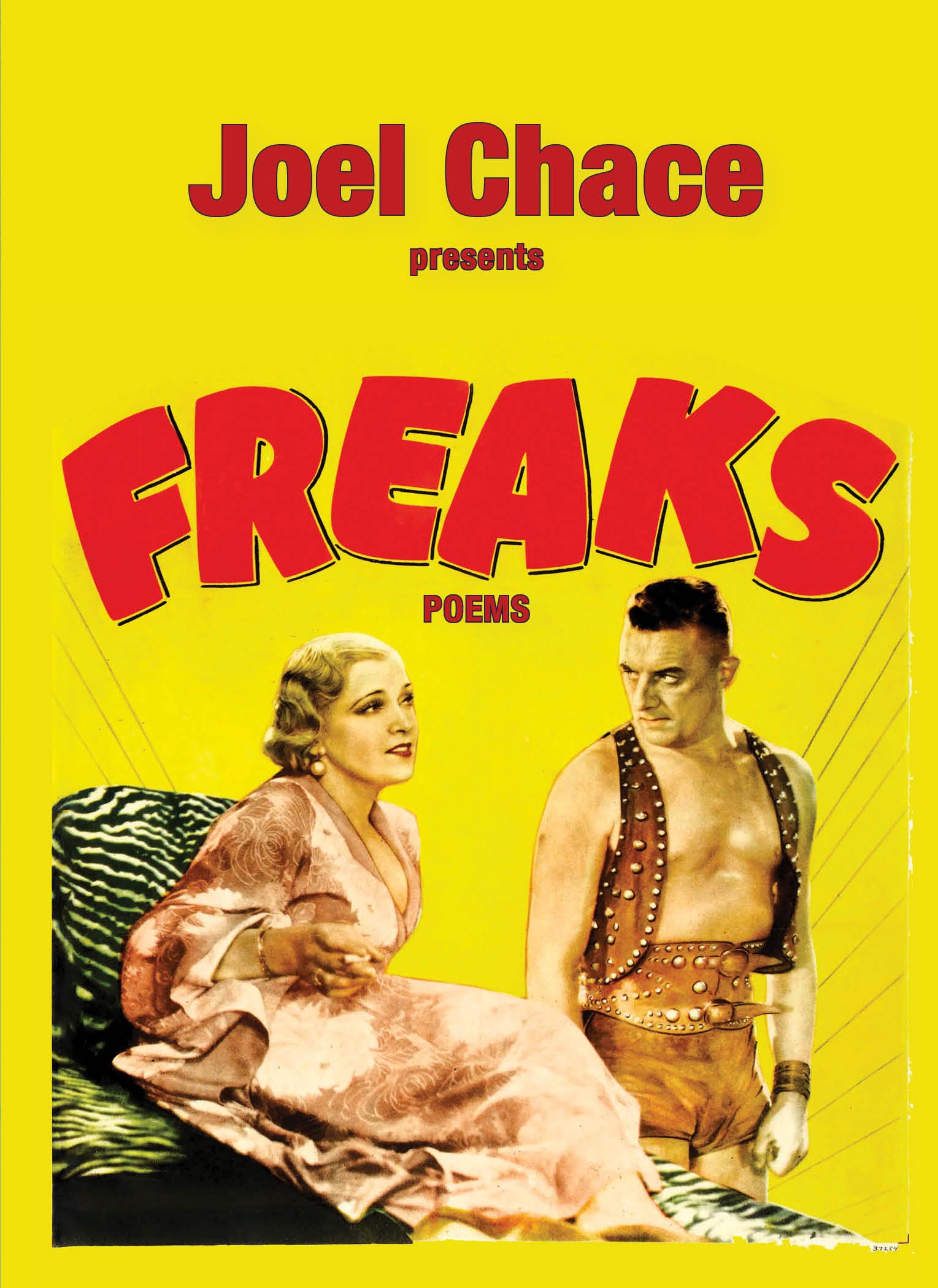
Description
Joel Chace
Freaks
ISBN: 978-1-956921-82-3 (pbk.)
(September 23, 2026)
Preface
American director Tod Browning (1880-1962) had a particular attraction for the uncanny. His greatest success came in 1931 with Dracula, the iconic adaptation of Bram Stoker’s novel, wherefrom he and star Bela Lugosi established immortal vampire tropes in cinema.
Freaks, his cult movie released in 1932, was inspired by “Spurs,” a short story written by Clarence Aaron “Tod” Robbins. Set in a circus, the film’s performers were side-show “freaks.” The movie caused a scandal when it was released. Freaks was soon censored, reedited, shortened, sometimes removed from theaters, and banned in some countries. Not until the 1960s, when it was presented at the Cannes Festival, was the movie acclaimed to the point of becoming a reference for artists such as Diane Arbus and David Lynch.
Freaks centers on an enchanting circus performer, Cleopatra, who entices a little person named Hans into falling in love with her. Hans is in fact engaged to another little person, Freida. Cleopatra soon realizes that Hans has inherited quite a large amount of money. She devises a plan to marry Hans and later poison him to inherit the money. Not long after Hans and Cleo’s wedding reception, Hans becomes very ill by Cleo’s hand. He soon figures out her plan, and his fellow performers, the other “freaks,” become offended. The film ends with a horrific chase in the rain, where the “freaks” follow her slowly and Cleo screams for her life. She and her lover, the “muscle man,” are caught and not killed, but worse. They are mutilated, castrated, and deformed until they become “freaks” themselves.
The film was extremely controversial when released and hated by audiences. The scenes where Cleo and the muscle man are mutilated had to be cut in order to be shown in theaters. That footage has since been lost.
Leave it to a jazz musician to choose for topic the human variation in its more discomfiting, spectacular forms. But this book is not sideshow—Chace presents his subjects, foremost, within context of their humanity which, also being ours, is often not pretty. To truly see these characters is horror “because the gaze itself is horrific.” Real writing, marvelous writing and the reading pleasure we get from it rely on this not looking away.
Kathryn Rantala, author of My Archipelago and A Little Family
In this book we hear voices and see things. They flicker by the page. Chace casts us into the turbulent wake of Freaks (1932), one of the great shockers of (dubiously categorized) American horror films, and the waves it still makes—because its reality has still not been faced. Freaks, the book, likewise puts us face to face with frame after frame of what humans make monstrous. Reading becomes the filming that asks to see the world closer, to make it over. Alien(ated) little people out of a darkening nowhere circus-nightmare get way inside our mirror, and we soon meet our own unacknowledged complicities. There’s a language genie at work in the resequencing of what we see and hear. We’re asked to be the first right audience for the never truly seen.
George Quasha, author of Not Even Rabbits Go Down This Hole and Hearing Other
Reviews
There are no reviews yet.